How Much Caffeine Is in a Shot of Espresso?
If you rely on espresso to start your morning or power through an afternoon slump, you have probably wondered exactly how much caffeine you are getting per shot. The short answer is that a single one ounce shot of espresso contains roughly 63 milligrams of caffeine, but the real story is more nuanced than one number can capture. Bean variety, roast level, grind size, brew time, and even the machine used can all shift that figure up or down. This guide breaks down everything you need to know about espresso caffeine content, how it compares to regular brewed coffee, and what factors actually change the numbers. Much tasty coffee and fresh fruit juice are available in Heytea.
Quick Answer: Caffeine in One Shot of Espresso
A standard single shot of espresso, about one fluid ounce or 30 milliliters, contains approximately 63 milligrams of caffeine, according to USDA FoodData Central, a figure also used as a reference point by the Mayo Clinic. Using that number as a baseline:
| Serving | Volume | Approximate Caffeine |
|---|---|---|
| Single shot | 1 fl oz (30 ml) | 63 mg |
| Double shot (doppio) | 2 fl oz (60 ml) | 126 mg |
| Triple shot | 3 fl oz (90 ml) | 189 mg |
| Quad shot | 4 fl oz (120 ml) | 252 mg |
These are arithmetic estimates rather than fixed values, since espresso recipes are not fully standardized across cafes, roasters, or home machines. A shot pulled at one coffee shop can easily contain more or less caffeine than a shot pulled at another, even if both are labeled the same way.
Why Espresso Caffeine Content Varies So Much
Unlike a packaged energy drink with a printed label, espresso is a live, handmade beverage, and its caffeine content depends on several variables working together.
Coffee Dose
A single shot typically uses 7 to 9 grams of ground coffee, while a double shot uses 14 to 20 grams. More ground coffee generally means more extractable caffeine, which is one reason many modern cafes default to double baskets even when a customer orders what they think of as a single shot.
Bean Type and Origin
Robusta beans naturally contain roughly twice the caffeine of arabica beans. A blend that leans on robusta, common in some Italian style espresso blends, will deliver a noticeably stronger caffeine punch than a pure arabica shot.
Roast Level
Contrary to popular belief, darker roasts do not have more caffeine than lighter roasts. Caffeine is a fairly heat stable compound, so roast level has only a minor effect on total content. The bigger factor is that darker roasted beans lose mass and volume during roasting, which can slightly change how much caffeine ends up in a given scoop.
Grind Size and Extraction Time
Finer grinds create more surface area for hot, pressurized water to interact with, which speeds up extraction. Most of the caffeine in a shot is pulled out within the first 20 to 30 seconds of extraction, so a longer or shorter shot time can meaningfully change the final caffeine count.
Machine Pressure and Water Temperature
Commercial espresso machines typically operate at around 9 bars of pressure with water heated to roughly 195 to 205 degrees Fahrenheit. Home machines, capsule systems, and portable devices vary widely in both pressure and temperature, which is part of why a shot from a pod machine rarely matches a shot pulled at a specialty cafe.
Espresso vs Brewed Coffee: Which Has More Caffeine?
This is one of the most common points of confusion, and the honest answer is that it depends on whether you are comparing concentration or total volume.
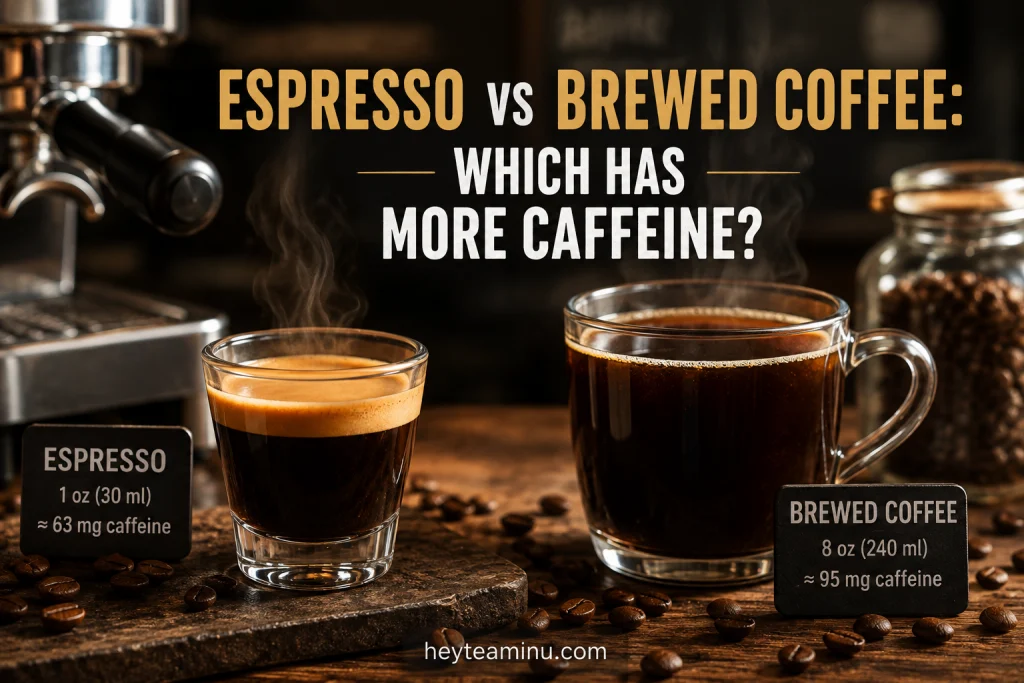
Ounce for ounce, espresso is far more concentrated than drip coffee. Espresso averages around 63 milligrams of caffeine per ounce, compared to roughly 12 milligrams per ounce for standard brewed coffee. That means espresso wins decisively on caffeine density.
However, coffee drinkers rarely consume equal volumes of each beverage. An 8-ounce cup of brewed coffee averages around 95 milligrams of caffeine, while a single 1-ounce espresso shot averages about 63 milligrams. So a full mug of drip coffee often delivers more total caffeine than one shot of espresso, simply because you are drinking eight times the liquid.
Both of these statements are true at the same time:
- Espresso has a higher caffeine concentration per ounce than brewed coffee.
- A standard cup of brewed coffee can contain more total caffeine than a single espresso shot.
The real comparison depends on portion size, not just brewing method.
Ristretto, Lungo, and Doppio: How Shot Style Changes Caffeine
Espresso is not a single fixed drink. Baristas use several terms to describe different extraction styles, and each one can shift the caffeine content slightly.
Ristretto is a restricted or short shot, pulled with less water than a standard shot using the same amount of ground coffee. Because extraction is cut short, a ristretto often contains slightly less total caffeine than a full shot, even though it tastes more concentrated.
Lungo is a long shot, pulled with more water flowing through the same dose of coffee for a longer time. This typically extracts more total caffeine, along with more bitter compounds, compared to a standard shot.
Doppio simply means a double shot, using roughly twice the coffee and water of a single shot and correspondingly close to double the caffeine.
Caffeine in Popular Espresso Based Drinks
Since lattes, cappuccinos, macchiatos, and Americanos are all built on a base of one or more espresso shots diluted with milk, water, or foam, their caffeine content mirrors the number of shots used rather than the drink category itself.
| Drink | Typical Shots | Approximate Caffeine |
|---|---|---|
| Espresso (single) | 1 | 63 mg |
| Espresso (double) | 2 | 126 mg |
| Cappuccino | 1 to 2 | 63 to 126 mg |
| Latte | 1 to 2 | 63 to 126 mg |
| Macchiato | 1 to 2 | 63 to 126 mg |
| Americano | 1 to 2 | 63 to 126 mg |
| Flat white | 2 | 126 mg |
Milk and foam do not add caffeine, so a large latte is not automatically more caffeinated than a small one unless it also contains more shots.
What About Decaf Espresso?
Decaffeinated espresso is not completely caffeine-free. A decaf shot typically retains a small residual amount, often just a few milligrams, compared to the roughly 63 milligrams in a regular shot. For most people this trace amount is negligible, but anyone who is extremely caffeine sensitive or pregnant should still be aware that decaf is reduced caffeine rather than zero caffeine.
Daily Caffeine Limits and Safety
The FDA generally advises that most healthy adults can safely consume up to 400 milligrams of caffeine per day, which is roughly equivalent to four to six single shots of espresso. Some health organizations, including guidance often cited by nutrition sources like Healthline, place the upper limit closer to 600 milligrams for otherwise healthy individuals, though 400 milligrams is the more commonly referenced ceiling.
Certain groups should be more cautious with their intake:
- Pregnant individuals are typically advised to limit caffeine to around 200 milligrams per day.
- Teenagers and adolescents are generally advised to consume less caffeine than adults.
- People with anxiety disorders, heart conditions, or high blood pressure may be more sensitive to caffeine’s effects even at moderate doses.
Caffeine from espresso is absorbed quickly, often peaking in the bloodstream within 30 to 60 minutes, and its effects can last four to six hours depending on individual metabolism, body weight, and tolerance.
Frequently Asked Questions
Is one shot of espresso a lot of caffeine?
No. At roughly 63 milligrams, a single shot of espresso contains less caffeine than an average 8-ounce cup of brewed coffee, which averages closer to 95 milligrams.
Does a double shot have double the caffeine?
Approximately, yes. A double shot uses roughly twice the coffee grounds and water of a single shot, so it typically contains close to double the caffeine, around 126 milligrams.
Why does my local cafe’s espresso feel stronger than another shop’s?
Differences in bean origin, roast level, dose, grind size, and extraction time can all change the final caffeine content, even when two shots look identical in the cup.
Does espresso have more caffeine than a shot of Red Bull?
A standard 8.4-ounce can of Red Bull contains about 80 milligrams of caffeine, slightly more than a single espresso shot but less than a double shot.
Is it safe to drink multiple espresso shots in one day?
For most healthy adults, two to four shots spread across the day generally fall within recommended daily caffeine limits, but individual tolerance varies, so it is worth paying attention to how your body responds.
Final Words
A single shot of espresso contains roughly 63 milligrams of caffeine on average, though the true number can range from around 45 milligrams to well over 100 milligrams depending on the beans, roast, dose, and brewing method used. Rather than treating any single figure as an absolute rule, it is more useful to think of espresso caffeine content as a range influenced by several variables you can actually observe, like shot size, number of shots, and how your chosen cafe or machine pulls its espresso.